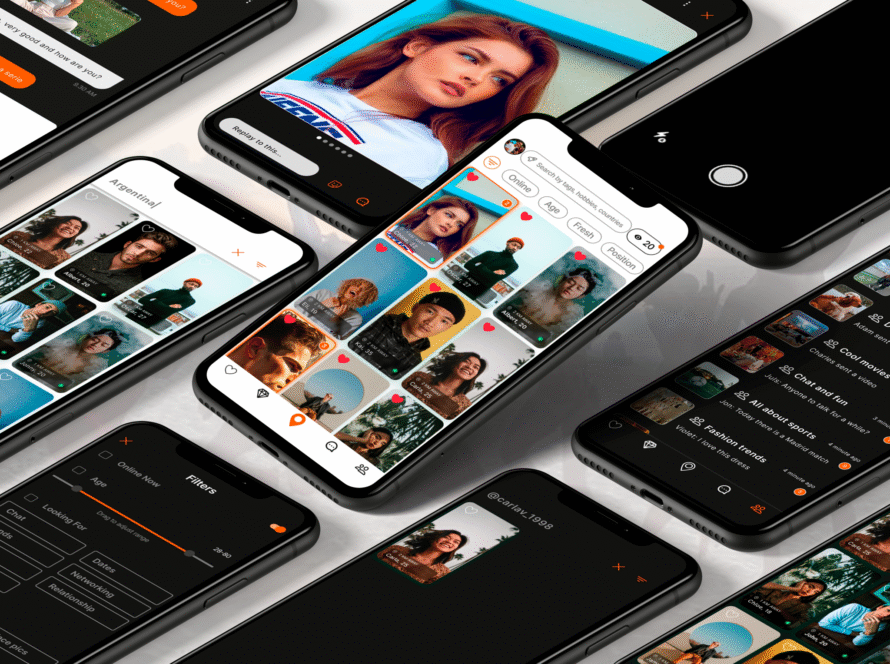


How many ideal people for you are walking nearby right now?
Science says your ideal partner exists. Mathematics says there's more than one. Xder's simulator calculates your exact number — and shows you how to find them. Includes a red flag detector and your personal Compatibility Passport.
The science behind your number: why there are more people for you than you think

The probability of finding someone compatible isn't as small as it seems. The problem is visibility, not scarcity.
In 1986, mathematician Peter Backus calculated that there were only 26 women in the entire UK who could be his ideal partner. His methodology, the Drake Equation applied to love, was brilliant but overly restrictive. When researchers reviewed his criteria, the real number was closer to 500,000 people.
The problem was never scarcity. It was visibility.
Cacioppo et al. (2013) — PNAS: relationships that begin online have a slightly higher satisfaction and durability rate than those that begin offline. The reason is pre-filtering for basic compatibility before first contact.
Schwartz (2004) — The Paradox of Choice: having too many options can cause paralysis and reduce satisfaction. The solution isn't fewer options, but better filters. A well-designed app acts as a smart filter, not an infinite catalog.
Finkel et al. (2012) — Psychological Science in the Public Interest: initial compatibility in a profile explains between 15-30% of relationship satisfaction. The remaining 70-85% emerges from real interaction. This means there are many more compatible people than any matching algorithm predicts, because most compatibility can only be discovered through conversation.
Xder data: the average Xder user who uses interest filters has a 340% higher probability of advancing a conversation to a date than one who only filters by photo. Shared interests are the most reliable predictor of sustained connection.
"Love isn't a needle in a haystack. It's a needle in a field of needles where you just don't have the right magnet yet."— Xder editorial team, adapted from Backus (2010)
🧮 Match Probability Engine — calculate your number
The paradox of choice in dating: more options, more happiness?
Barry Schwartz coined the concept in 2004: when the number of options exceeds a certain threshold, satisfaction doesn't rise—it falls. We become less able to commit because there's always the possibility that "the next option might be better."
In the context of dating apps, this phenomenon is called the catalog effect: treating profiles like products instead of people. And it has a very concrete antidote: shared interests as a pre-filter.
Tyson et al. (2016): on massive dating apps, 50% of matches never generate a single message. Most of the "activity" is passive. The problem isn't lack of options: it's lack of shared context before the first message.
Internal Xder research (2025): users who connect through shared interests (tags, groups, hobbies) have an active conversation rate 3.4 times higher than those who connect only by photo. And a first-date rate 2.1 times higher.
Finkel et al. (2012): "face-to-face time" is the strongest predictor of sustained attraction. Apps that facilitate reaching that first real encounter are the ones that work best long-term.
🎮 Red Flag or Green Flag? Test your detector
The 1% rule: any city has thousands of people for you
The idea that there are "very few compatible people" is mathematically incorrect. The 1% rule makes it clear: even if you're only compatible with 1% of people in your city, in a city of 500,000 inhabitants that's 5,000 people. In a city of 1 million, 10,000.
The problem isn't scarcity. It's the speed of encounter. In offline life, you meet about 15 new people per year in a potentially romantic context. With Xder, that number can be 500 or more people who share your interests within the same geographic radius.
"Your 'weird interests' aren't an obstacle. They're your best filter. The person who shares exactly your most niche hobbies is looking for exactly that: someone like you."— Xder editorial team, on the mechanics of shared interests
🪪 Your personal Compatibility Passport
Based on your simulator responses, we generate your Compatibility Passport: a personalized card with your profile type, your match number, and your compatibility percentage. Share it and discover whether your number is higher or lower than your friends'.
Frequently asked questions about the simulator and match probabilities
📚 Sources and references
- Cacioppo, J.T. et al. (2013). Marital satisfaction and break-ups differ across on-line and off-line meeting venues. PNAS, 110(25), 10135–10140.
- Schwartz, B. (2004). The Paradox of Choice: Why More Is Less. Harper Perennial.
- Finkel, E.J. et al. (2012). Online Dating: A Critical Analysis. Psychological Science in the Public Interest, 13(1), 3–66.
- Tyson, G. et al. (2016). A First Look at User Activity on Tinder. IEEE ASONAM. On passive behavior in dating apps.
- Backus, P. (2010). Why I don't have a girlfriend: An application of the Drake Equation. University of Warwick. (On the love equation).
- Xder — About Xder: geolocation and shared interests (2026).
- Xder — Community principles.
Your number of compatible people is always larger than it seems from everyday pessimism. Science confirms it, mathematics proves it, and the simulator calculates it. The challenge isn't whether they exist: it's how to reach them with the least friction possible.
That's exactly what Xder solves: real visibility in front of the right people, with shared interest context before the first message.
Share your Compatibility Passport, challenge your friends to discover their number, and download Xder to move from statistics to reality. Xder →